
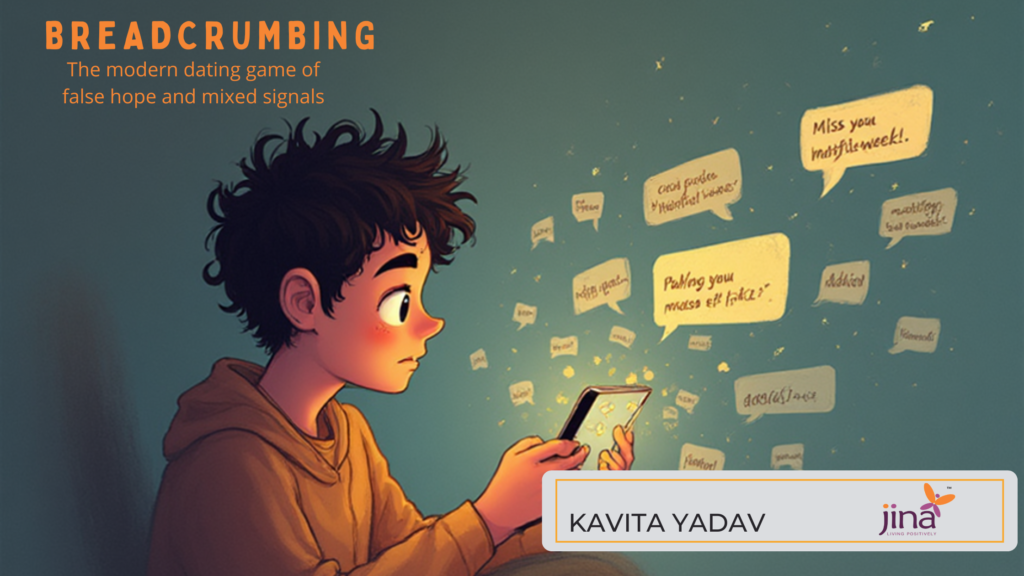
“Sometimes the hardest relationships to leave are the ones that never fully began.”
In the world of modern relationships, especially in the age of digital communication, new patterns of behaviour are constantly emerging. One such pattern that many people experience but struggle to name is breadcrumbing.
If you have ever felt that someone keeps you emotionally engaged without truly committing to the relationship, you may have encountered this phenomenon.
What is Breadcrumbing?
Let us understand …. The term breadcrumbing comes from the fairy tale Hansel and Gretel, where breadcrumbs were scattered along the path.
In relationships, breadcrumbing refers to a situation where one person offers small, occasional signals of interest or affection just enough to keep the other person emotionally invested, but never enough to build a genuine relationship.
These “breadcrumbs” can appear in different forms:
- Occasional messages like “Hey, just thought of you.”
- Random compliments after long periods of silence
- Flirtation without any intention of meeting or deepening the connection
- Promises of meeting “soon” that never materialise
- Keeping communication alive without moving towards commitment
The person doing the breadcrumbing keeps the door slightly open, ensuring the other person does not completely walk away.
The Psychology Behind Breadcrumbing
Most people who breadcrumb are not always consciously manipulative. Often, the behaviour stems from deeper psychological patterns.
- Fear of Commitment
Some individuals enjoy emotional attention but feel anxious about deeper intimacy. Breadcrumbing allows them to keep someone close without the responsibility of a real relationship.
- Need for Validation
Attention can become a source of self-worth. Knowing that someone is waiting, responding, or emotionally invested can boost the person’s ego.
- Avoidant Attachment Style
People with avoidant attachment patterns often desire connection but feel uncomfortable with emotional closeness. Breadcrumbing allows them to maintain distance while still feeling connected.
- Keeping Options Open
In the age of dating apps and constant choices, some individuals keep multiple connections alive as “emotional backups”.
- Emotional Immaturity
Sometimes it is simply a lack of emotional awareness. The person may not fully understand how their inconsistent behaviour affects others.
How Breadcrumbing Impacts the Other Person
For the person on the receiving end, breadcrumbing can be deeply confusing and emotionally draining.
- Emotional Uncertainty
The relationship feels ambiguous. There is just enough hope to stay, but never enough clarity to feel secure.
- Self-Doubt
People often begin questioning themselves:
- Did I misunderstand the signals?
- Am I expecting too much?
- Maybe if I try harder, things will change.
- Delayed Healing
Because the relationship never fully ends, it becomes difficult to emotionally move on.
- Reduced Self-Worth
Constant inconsistency can slowly erode confidence, making the person feel less valued.
- Emotional Exhaustion
Waiting for replies, interpreting messages, and managing uncertainty can become mentally exhausting.
Why Breadcrumbing Can Be Hard to Recognise
Breadcrumbing rarely looks like rejection.
Instead, it looks like possibility.
The occasional message, the sudden warmth after distance, or the promise of meeting “soon” creates a loop of hope.
Psychologically, this pattern resembles intermittent reinforcement, the same principle that makes certain behaviours addictive. When attention comes unpredictably, it becomes harder to walk away.
What Can One Do If They Are Being Breadcrumbed?
Awareness is the first step.
Ask yourself a few honest questions:
- Is this relationship moving forward or staying in the same uncertain space?
- Do their actions match their words?
- Do I feel emotionally secure, or constantly confused?
Healthy relationships are not built on mixed signals. They are built on consistency, clarity, and mutual effort.
Sometimes the most powerful step is to stop chasing breadcrumbs and look for a connection that offers the whole loaf.
Relationships should not feel like puzzles that constantly need decoding.
When someone truly values you, their presence feels steady, not sporadic. Their care feels intentional, not occasional.
You deserve a relationship where you are chosen clearly, not kept as an option.
Have you ever experienced breadcrumbing, or noticed this pattern around you?
How do you think such behaviours impact couple relationships and emotional wellbeing?
I would love to hear your reflections.
Share your thoughts in the comments or reach out if you would like to explore this topic deeper in conversations around relationships and emotional health.