
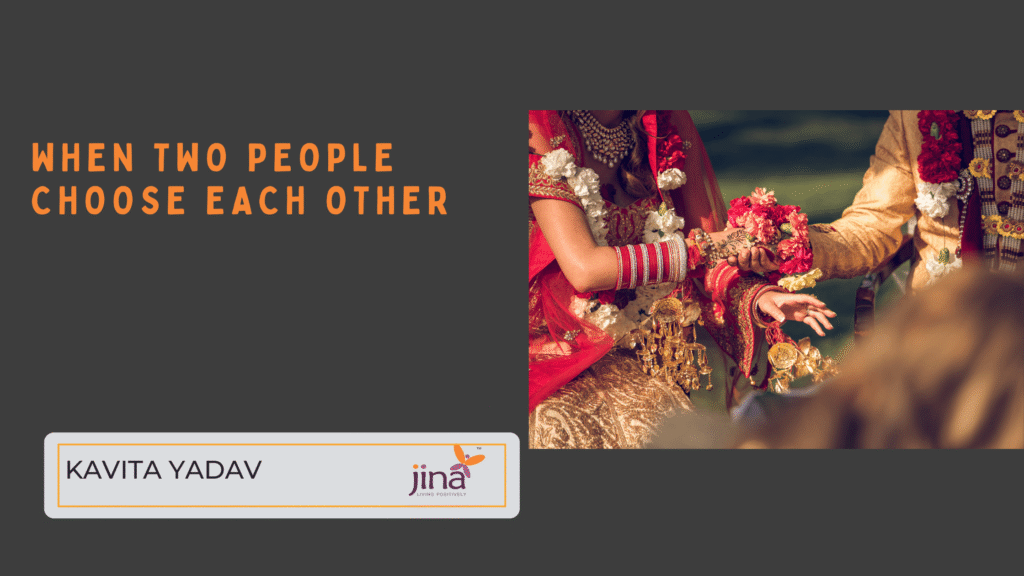
Whether it’s a love marriage or an arranged one, at some point, two individuals look at each other and say, “Yes, let’s do life together.”
There is something deeply human and beautiful about this decision.
Beyond compatibility charts, shared values, family approval, or chemistry, there is always an emotional pull. A quiet belief that this person brings something into my life that I need. Stability. Warmth. Direction. Freedom. Safety. Excitement. Grounding.
Often, partners are drawn to each other not because they are the same, but because they are different.
One is calm, the other expressive.
One is structured, the other spontaneous.
One is emotional, the other practical.
And somewhere deep within, there is a hope, sometimes conscious, often unconscious:
“This person will balance me.”
Isn’t that beautiful?
Yes… it is.
And yet, this is where psychology gently taps our shoulder and asks us to pause.
- When Balance Turns into Blind Spots
While differences can bring balance, they can also hide unseen emotional patterns.
Many times, what we experience as attraction is also familiarity — familiarity with what we have known growing up.
We may choose:
• Someone who feels emotionally distant because that’s what love looked like at home
• Someone overly giving because we learned to earn love
• Someone dominant because we associate control with safety
• Someone dependent because being needed gives us a sense of worth
These are not flaws.
They are unexamined patterns.
And if left unaddressed, they quietly shape the relationship.
- Common Psychological Blind Spots in Relationships
Some patterns that often go unnoticed in a couple relationship:
1. Expecting your partner to heal you
Your partner can support your healing, but they cannot become your therapist, parent, or emotional crutch.
2. Confusing adjustment with self-erasure
Compromise is healthy. Losing your voice, values, or identity is not.
3. Mistaking emotional intensity for emotional intimacy
Strong emotions do not always mean deep connection. Intimacy grows through safety, consistency, and mutual respect.
4. Replaying childhood roles
Many couples unknowingly recreate parent-child dynamics in marriage. One becomes the caretaker, the other the dependent.
5. Avoiding difficult conversations to “keep peace”
Unspoken resentment does not disappear. It waits.
- Becoming Aware: The First Step Towards a Healthy Relationship
Always remember that awareness does not mean blame. It means curiosity.
Ask yourself gently:
• What attracted me to my partner at an emotional level?
• What do I expect them to fix or fill in my life?
• How do I react during conflict: withdraw, attack, submit, control?
• What patterns from my family am I carrying into this relationship?
Self-awareness creates choice. Without it, we only react.
- Moving Forward: From Unconscious Bonding to Conscious Partnership
Healthy relationships are not about perfection. They are about intentional growth.
Sharing what can help to build healthy relationships:
• Building emotional literacy. Start by naming feelings instead of acting them out.
• Taking responsibility for your triggers keeps you grounded.
• Creating space for honest, respectful dialogue is a step forward.
• Seeking counselling not as a last resort, but as a preventive tool, is maturity.
• Understanding that love is not just a feeling, it’s a practice.
When two people choose to grow together instead of growing apart, the relationship matures beautifully.
Yes, it is beautiful when two people come together, hoping to balance each other.
But the real beauty lies in this:
Two emotionally aware individuals choosing to walk together, not to complete each other, but to complement, challenge, and support each other’s becoming.
Love flourishes not when we ignore our blind spots, but when we have the courage to look at them – together.